
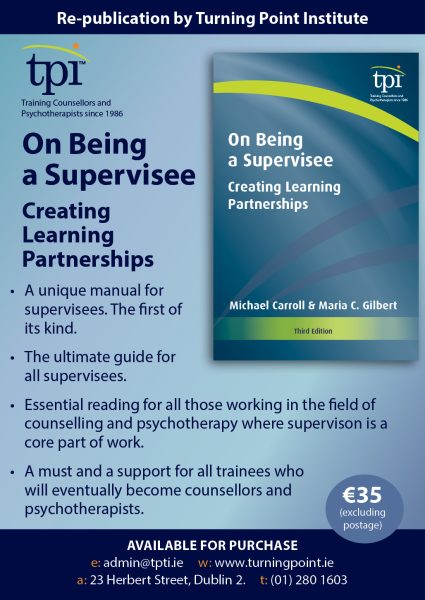
On Being a Supervisee – Carroll and Gilbert – 3rd Edition
There are many books on supervision and how to be a supervisor and almost none on how to be a supervisee. This manual is therefore primarily for supervisees, arguably the most important person in supervision.
It will lead you through the various stages of understanding, setting up, contracting for, maintaining and ending a supervisory relationship.
This manual is not intended to be read straight through from beginning to end. It has been divided into three sections to make it more accessible depending on the stage of the supervisory relationship.
The authors hopes are to empower supervisees in all aspects of the supervisory relationship.
This book is only available to buy at Turning Point Institute.
Living After Death
How we choose to regard death is one of the most difficult decisions of our lives. It challenges us morally, emotionally and spiritually. We are challenged to make this choice whether contemplating our own death or the death of someone close.
We must live in the present. We must let go of the past. And we must grieve.
This thorough and sensitive book is intended for those who are facing the prospect of the death of a loved one and for those who are bereaved.
It is filled with the experience and insight of a professional psychotherapist and offers practical down-to-earth advice and encouragement for every stage of the journey.
This book is only available to buy at Turning Point Institute.
On becoming a person
In this book, one of America’s most distinguished psychologists describes his experiences in helping people to discover the path to personal growth through an understanding of their own limitations and potential. What is personal growth? Under what conditions is it possible? How can one person help another? What is creativity, and how can it be fostered? These are some of the issues raised, which challenge many concepts of traditional psychology. Contemporary psychology derives largely from the experimental laboratory, or from Freudian theory. It is preoccupied with minute aspects of animal and human behaviour, or with the mentally ill. But there are rebels, of whom the author counts himself as one, along with Gordon Allport, Abraham Maslow and Rollo May, who feel that psychology and psychiatry should be aiming higher, and be more concerned with growth and potentiality in man. The interest of such a psychology is in the production of harmoniously mature individuals, given that we all have qualities and possibilities infinitely capable of development. Successful development makes us more flexible in relationships, more creative, and less open to suggestion and control. This book, philosophical and provocative, summarizes Dr Rogers’ experience. Non-technical in its language, it is not only for psychologists and psychiatrists, but for teachers and counsellors, religious and social workers, labour-management specialists and anyone interested in ‘becoming’.
Basic Counselling Skills by Richard Nelson-Jones
Basic Counselling Skills by Richard Nelson-Jones
Presents an introduction for those using counselling skills in the course of their work. This book covers topics such as: starting and structuring the helping process; active listening; offering challenges and feedback; facilitating problem-solving; coaching, demonstrating and rehearsing; and strategies for changing thinking.